December 1, 2025
How one of the world’s most diverse habitats can be found right beneath our feet
We’ve all heard about the Amazon rainforest and coral reefs and their importance to global ecology. Perhaps less celebrated, and much closer to home, is a habitat that competes with them for biodiversity – calcareous grassland.
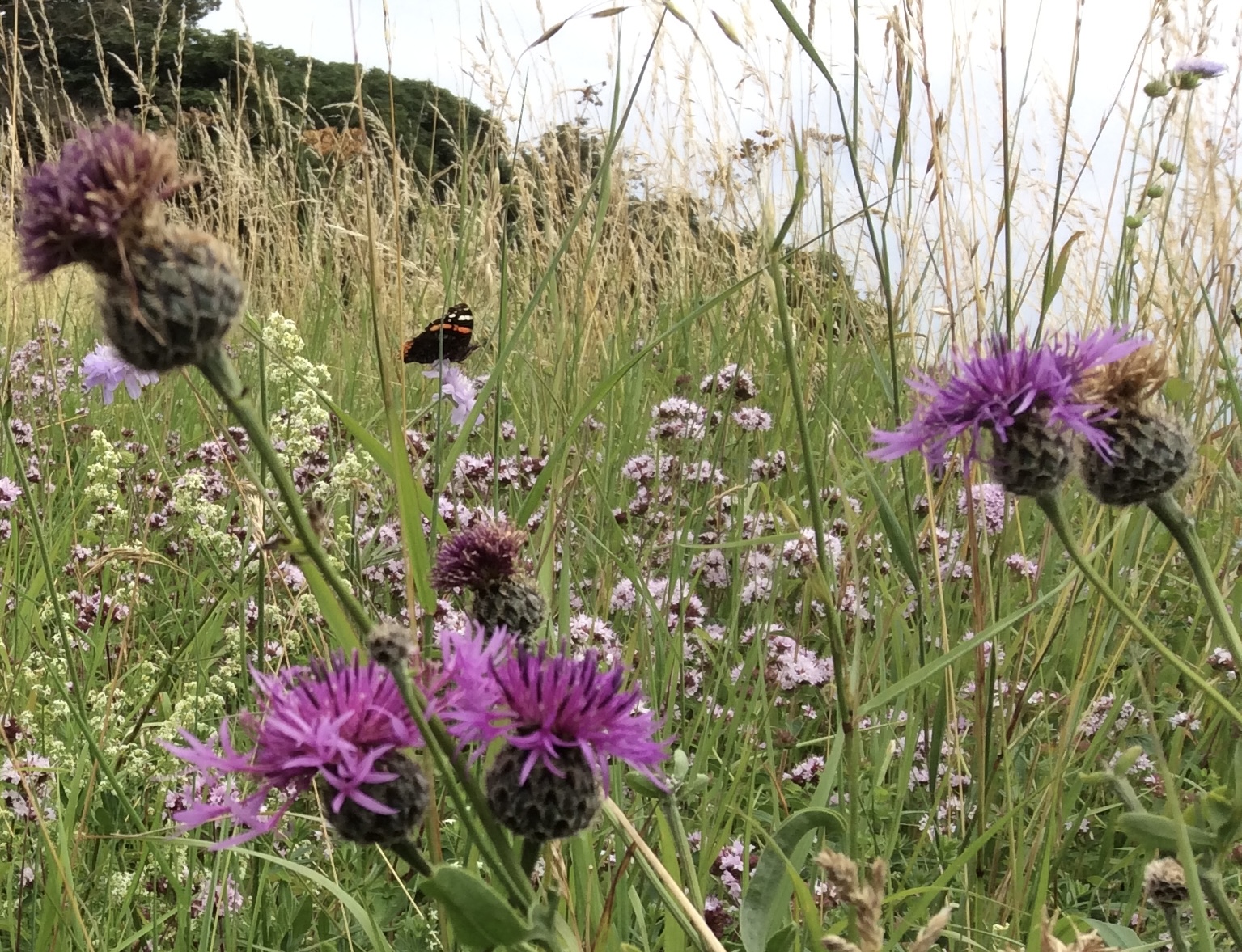
Areas of this chalky soil, found scattered across the South Downs and elsewhere in the UK, is among the most ecologically valuable places on Earth. According to the Wildlife Trust, this valuable grassland can include up to 40 plant species packed into a single square metre.
Calcareous grassland creates a home to rare butterflies, specialist invertebrates and a distinctive mosaic of scrub species – and is therefore a crucial building block in a return to nature.
Despite its importance, more than 80 percent of the UK’s calcareous grassland has been lost between 1945 and 1984, with losses still continuing. As part of our renaturing and biodiversity net gain project at Halnaker Hill Farm, we’re helping it to return.
Why is calcareous grassland so valuable?
Our farm sits on land that was intensively farmed for wheat from the 1970s onwards, with the use of fertilisers and pesticides to encourage a monoculture. This is where one species forces out others. That’s what food farmers want to happen – but when it comes to encouraging biodiversity, nutrient-poor soil is far better.
Will Atkinson, our Agri-Environment consultant, explains: “Unimproved chalk grassland is one of the most biodiverse places on Earth and as soon as you put fertiliser on it, grass fed by nutrients will out-compete the wild flowers and plants. Here, we want grass to do very poorly – it’s really the opposite of what farmers normally want to do.”
It will take time for our soil to recover from years of agriculture – with help from the farm’s expert team, as Nick Heasman, Consultant Ecologist to our project, describes: “There are still residual chemicals in the soil but over time, they’ll dissipate. We’re actively working to strip them out. We've sown grass that pulls up phosphates and nitrates from the soil, and as we cut and remove the growth it takes that fertility, and those chemicals, with it.”
The results are already being seen as insects and bird species return – with our humble chalky soil driving the resurgence.
“With a diverse hedgerow, with 15 or so different plant species, butterflies can move through happily,” Nick adds. “Young birds and adults benefit too – they find food, shelter and safe passage through the landscape. A lot of species don’t want to be isolated. They need movement, migration routes, new genetic material coming in. That’s what we’re aiming to create.”
Restoring calcareous grassland is a fundamental pillar of Halnaker Hill Farm’s restoration and our delivery of 856 biodiversity net gain units across 330 acres.
A rich, mixed habitat that will provide biodiversity for generations to come
At Halnaker Hill Farm, we have various habitats of medium and high distinctiveness alongside calcareous grassland including hedgerows, lowland, other neutral grassland, mixed scrub, ponds, individual trees and woodland.
Overall, our BNG scheme, commercially managed by Kingsbridge, will contribute significantly to the wider Government and South Downs National Park target of renaturing 33% of the South Downs by 2030.
Whether you're a developer, a company with ESG goals, or an individual who simply wants to leave the planet better than you found it, Halnaker Hill Farm offers a unique opportunity to invest in a greener, more biodiverse future.
For more information on BNG units or how to get involved, contact us.